
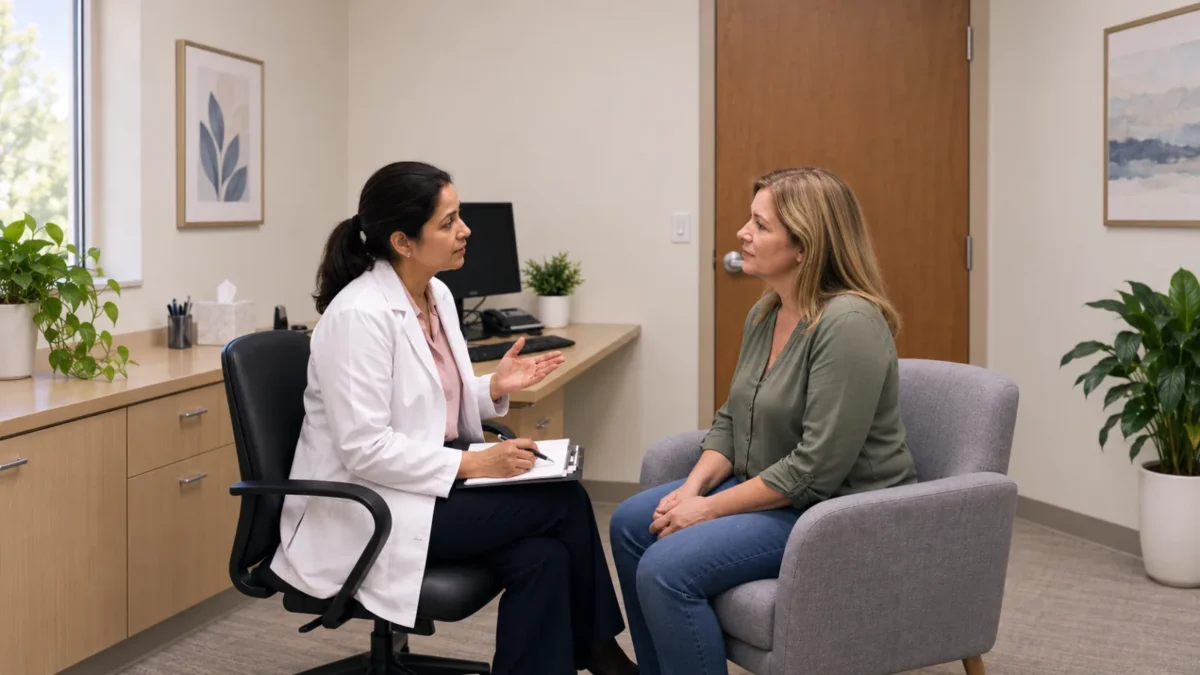
Vaginal Dryness During Menopause: A Practical Conversation Guide
Vaginal dryness can become more noticeable around menopause and can affect comfort during daily life or sex. Lubricants and vaginal moisturizers serve different purposes; persistent pain, irritation or other changes warrant an individualized evaluation.
In this article
- What is the difference between moisture support and friction support?
- Describe dryness and discomfort in plain language
- What causes vaginal dryness during menopause?
- Product choices should match the symptom
- When to discuss additional local care
- How should you bring this up with a clinician?
- Persistent discomfort needs a proper check
- A practical next step with Direct Preventive Care
Local discomfort deserves plain language, not embarrassment. If you are dealing with vaginal dryness around menopause, the first task is to describe what you feel and separate two kinds of support: moisture support for day-to-day dryness and friction support for comfort during contact.
Both can matter. They are not the same thing. And if symptoms continue, your clinician can help sort out whether over-the-counter care is enough or whether another care option should be discussed.
What is the difference between moisture support and friction support?
Moisture support is for ongoing tissue dryness. Friction support is for moments when rubbing, touch, or penetration causes irritation or pain.
A vaginal moisturizer is used to help the tissue hold moisture over time. A lubricant is used to reduce friction during contact. ACOG describes both as over-the-counter options for vaginal dryness and painful sex, while The Menopause Society explains that moisturizers and lubricants can help maintain moisture and reduce friction when dryness contributes to pain. (acog.org)
That distinction helps you ask a more focused question: “What problem am I trying to solve?” Tell the clinician whether discomfort happens day to day, during contact, or both.
|
Option |
Main purpose |
Best fit |
What to know |
|---|---|---|---|
|
Vaginal moisturizer |
Helps with ongoing dryness |
Day-to-day dryness, tissue tightness, mild irritation not tied only to contact |
Intended for ongoing moisture support; ask how to use the product |
|
Lubricant |
Reduces rubbing and friction |
Comfort during sex, pelvic exams, or other contact |
Intended to reduce friction during contact; persistent dryness may need additional assessment |
Describe dryness and discomfort in plain language
You do not need medical terms to start the conversation. Say what is happening in normal words: “I feel dry,” “It burns after contact,” “I feel tight,” “It feels like paper cuts,” or “I avoid intimacy because I expect pain.”
ACOG’s menopause guidance explains that declining estrogen can make the vaginal lining thinner, drier and less elastic. That can contribute to pain with sex. Describe your experience rather than assuming every symptom comes from the same change.
These are common menopause symptoms, but common does not mean you have to ignore them. Local tissue discomfort can affect walking, exercise, clothing choices, sleep, pelvic exams, and close relationships. Hormones change. Care should keep up.
What causes vaginal dryness during menopause?
The main driver is often lower estrogen, which changes the tissue that lines the vagina and supports the vulvar area. Clinicians often describe this as part of genitourinary syndrome of menopause, a term that includes vaginal, vulvar, and urinary changes related to lower estrogen.
In real life, you may simply notice dryness, burning, itching, soreness, pain with contact, or more urinary irritation than before. Symptoms can build gradually. They can also show up after months of feeling “mostly fine.”
Dryness and pain can have more than one explanation. Share your medicines, health history, products you have tried and any new symptoms so the clinician can decide what needs assessment.
Product choices should match the symptom
Start by matching the support to the setting. If you feel dry most days, a moisturizer may be the more logical first conversation. If discomfort happens mainly with contact, a lubricant may be the missing piece. If both are true, both may be discussed.
Useful product features to ask about include:
-
Purpose: Is the product intended for ongoing moisture support or friction during contact?
-
Comfort: What should I do if a product burns, itches or feels uncomfortable?
-
Compatibility: Is it compatible with condoms or other products I use?
-
Instructions: How should I use it, and when should I ask for reassessment?
When to discuss additional local care
If moisturizers and lubricants do not provide enough comfort, discuss the next step with a clinician. The Menopause Society’s sexual-health guidance describes several causes of pain and options for professional assessment. A recommendation should fit the concern and your health history.
Local therapy is different from treating the whole body for every menopause concern. The goal is specific: improve local tissue comfort when symptoms and health history support that plan. Your clinician should review your medical history, bleeding history, breast health history, medications, risk factors, preferences, and prior treatments before recommending anything.
This is where a focused visit helps. You should not be rushed into a treatment. You should understand the reason, the alternatives, the limits, and the follow-up plan.
How should you bring this up with a clinician?
Be direct. Clinicians hear private concerns every day, and clear language helps them help you faster.
You can start with one sentence: “I’m having vaginal dryness and discomfort, and I want to understand my options.” That is enough. You do not need to apologize, minimize it, or wait until symptoms are severe.
Before your visit, write down:
-
Where you feel symptoms: inside, outside, at the opening, or with urination.
-
What it feels like: dry, burning, tearing, itching, tight, sore, or raw.
-
When it happens: daily, after exercise, during contact, after contact, or during pelvic exams.
-
What you have tried: moisturizers, lubricants, soaps changed, prescriptions, or avoidance.
-
What worries you: hormones, safety, cost, privacy, cancer history, or not being heard.
Clear notes make the visit more useful. They also help your clinician decide whether the next step is education, product adjustment, exam, testing, prescription discussion, or referral.
Persistent discomfort needs a proper check
If discomfort keeps coming back, worsens or does not respond to basic care, ask for an assessment. A clinician may recommend an examination or selected testing depending on your symptoms and history.
Report new symptoms as well as dryness, including bleeding, discharge or urinary discomfort. Also speak up if pain affects relationships or makes you avoid needed examinations. Ask when a concern needs prompt attention rather than assuming that menopause explains it.
Bring your symptom and medicine information, then ask what evaluation and choices fit your situation. Your care. Your questions. A plan that fits.
A practical next step with Direct Preventive Care
Direct Preventive Care serves Winter Garden and the Orlando area, with care that may be available virtually or in person depending on your clinical needs and the service. The team reviews symptoms, health history, medications, goals, and relevant records before discussing options, and decisions remain individualized. (directpreventive.com)
For next steps, you can explore DPC’s women’s hormone care or menopause care. Bring your questions. Bring your symptoms. We’ll help you sort through the options without pressure.
This article provides general education. Individual treatment decisions belong in a conversation with a qualified clinician.