
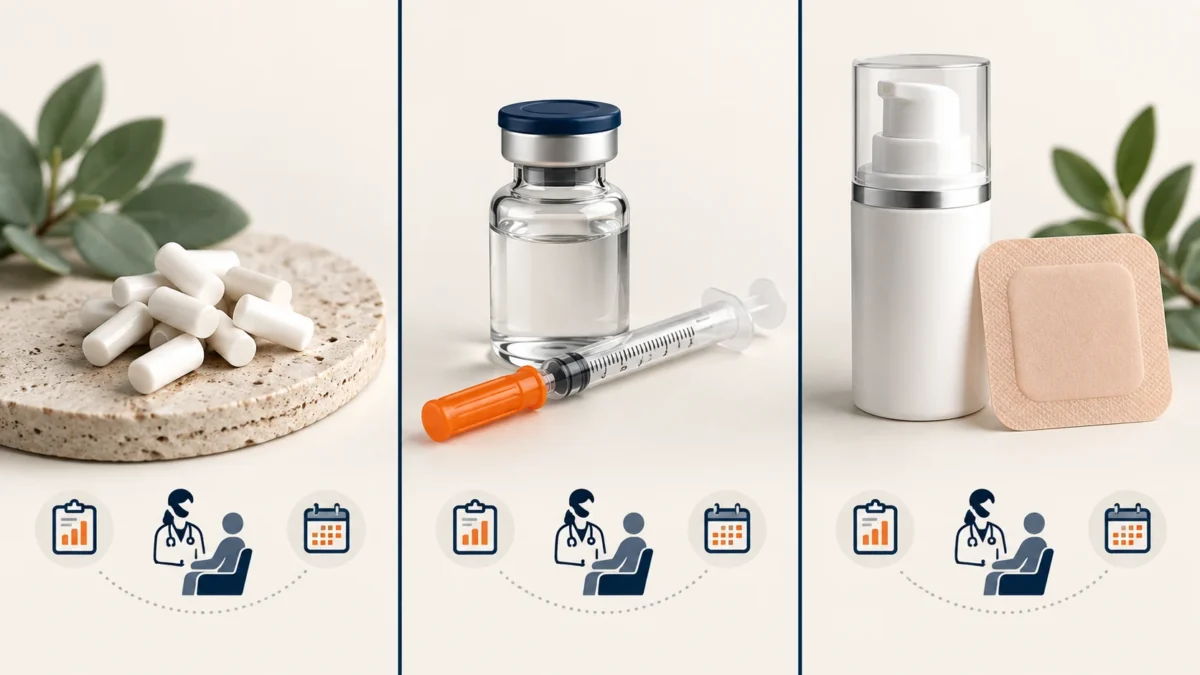
Hormone Pellets vs Injections vs Creams: How to Compare
Pellets, injections, and creams differ in administration, adjustability, routine, monitoring, and cost. There is no universal winner; the best fit depends on the specific hormone, health history, goals, and clinician guidance.
In this article
- How should you compare hormone pellets, injections, creams, and patches?
- The main comparison points
- Which option is easier to adjust or pause?
- Testosterone pellets vs injections
- Estrogen pellets vs patch
- Which option fits your day-to-day routine?
- Cost questions to ask before choosing
- Labs help answer a clinical question
- A neutral decision framework
- What DPC can help you sort through
- The bottom line
Hormone options can sound simple online. They are not simple in real life.
Pellets, injections, creams, gels, and patches are delivery methods. The right conversation starts with your symptoms, health history, goals, labs, and clinician judgment, not with a pre-picked product. Direct Preventive Care in Winter Garden serves adults across the Orlando area with individualized evaluation and monitoring for hormone care, including education about hormone pellet therapy and clinically guided lab testing. (directpreventive.com)
How should you compare hormone pellets, injections, creams, and patches?
Compare them by how they are given, how often you deal with them, how easily the plan can be adjusted, what monitoring looks like, how they fit your day, and what the total cost may include. That framework is more useful than asking which method is “best.”
Hormones change. Care should keep up.
Medical groups also emphasize individualized decision-making. The Menopause Society states that hormone therapy decisions should use shared decision-making and periodic reevaluation, including the appropriate dose, duration, regimen, and route for the person’s goals. The Endocrine Society recommends that testosterone care be based on symptoms plus consistently low testosterone levels, with evaluation and follow-up rather than guesswork. (menopause.org)
A useful first filter looks like this:
- Pellets may fit someone who wants a longer treatment cadence and fewer at-home steps, while understanding that changes may not be as immediate once placed.
- Injections may fit someone who is comfortable with scheduled dosing and wants a method that can be discussed and adjusted at follow-up visits.
- Creams or gels may fit someone who is comfortable applying medication consistently as directed.
- Patches may fit when a clinician recommends a transdermal option, often discussed in estrogen care, and the patient can follow the replacement schedule.
That is not a ranking. It is a starting point.
The main comparison points
When people search for hormone pellets vs injections, testosterone pellets vs injections, or estrogen pellets vs patch options, they often get strong opinions. Strong opinions are not the same as a clinical plan.
Here is the calmer way to compare.
Administration method
This is the “how does it get into my body?” question.
- Pellets: A clinician places small pellets under the skin during an office visit. After placement, there is no daily application step.
- Injections: Medication is injected on a schedule set by the clinician. Some people receive injections in a clinic, while others may be taught a home routine if appropriate.
- Creams or gels: Medication is applied to the skin or a specific area as directed. Consistency matters because missed applications can affect the plan.
- Patches: A patch is applied to the skin and changed on a prescribed schedule. This is commonly discussed in estrogen care when a transdermal route is being considered.
The practical question is not only “Can I do this?” It is “Can I do this correctly over time?”
Treatment cadence
Cadence means how often the treatment shows up in your calendar.
- Pellets: Usually involve an office-based placement and a longer interval before the next treatment discussion.
- Injections: Require recurring doses on a schedule. That schedule becomes part of your week or month.
- Creams or gels: Usually require frequent application. The routine is simple, but it asks for consistency.
- Patches: Require patch changes on a schedule. You have to remember the timing and placement instructions.
A longer cadence is not automatically better. A shorter cadence is not automatically worse. It depends on what you can follow, what your clinician is treating, and how your monitoring plan is built.
Monitoring and follow-up
Hormone care should not be “start and disappear.”
Monitoring may include symptom review, lab review, medication review, and a conversation about whether the plan still fits your goals. Direct Preventive Care describes its approach as connected care with lab interpretation, monitoring, and decision support for patients in Winter Garden, Orlando, Horizon West, Windermere, and West Orange County. (directpreventive.com)
For testosterone care, the Endocrine Society guideline discusses diagnosis, evaluation for the cause of low testosterone, and follow-up after treatment starts. It also notes that formulation choice can involve patient preference, treatment burden, and cost. (academic.oup.com)
Clear numbers. Room for your questions.
Which option is easier to adjust or pause?
In general, creams, gels, patches, and injections are usually more directly adjustable because the schedule is ongoing. Pellets are placed for a longer interval, so conversations about timing and adjustment are different.
That difference matters.
If your main concern is flexibility, ask your clinician how each method would be changed if your goals, symptoms, labs, or medical picture changes. Do not assume the answer is the same for testosterone, estrogen, progesterone, or other hormones.
Use these questions in your visit:
- If we start with this method, when would we reassess?
- What information would lead us to continue, adjust, pause, or change routes?
- How do labs fit into that decision?
- What symptoms should I track between visits?
- What happens if my goals change?
- Are there other non-hormone factors we should evaluate first?
Your body is not a template. Your plan should not be either.
Testosterone pellets vs injections
Testosterone care is one of the most common reasons people compare pellets and injections. The choice is not just about preference. It depends on whether testosterone treatment is appropriate in the first place.
The Endocrine Society recommends diagnosing testosterone deficiency in men only when symptoms and signs are present along with consistently low testosterone levels. It also recommends additional evaluation to understand the reason for low testosterone before treatment decisions are made. (academic.oup.com)
When comparing testosterone pellets vs injections, focus on these points:
- Administration: Pellets are placed during an office visit. Injections are given on a recurring schedule.
- Cadence: Pellets reduce frequent dosing steps. Injections require repeated dosing at planned intervals.
- Adjustability: Injections create recurring points for dose discussions. Pellets require a different timing conversation because they are already placed.
- Follow-up: Both should involve symptom review and lab-informed monitoring.
- Routine: Pellets shift the routine toward office visits. Injections shift the routine toward scheduled dosing.
- Cost questions: Ask what is included in evaluation, labs, medication, visits, and follow-up.
No method removes the need for a real evaluation. If a plan starts before your history, symptoms, medications, goals, and labs are reviewed, slow down and ask why.
Estrogen pellets vs patch
Estrogen conversations often include patches, creams, pills, rings, or pellets depending on the clinical situation. Available options vary based on the hormone being treated, your medical history, treatment goals, and clinician judgment.
When people compare estrogen pellets vs patch options, the real comparison is route and plan design.
- Pellets: Office-based placement with a longer treatment interval.
- Patch: Skin-based delivery changed on a prescribed schedule.
- Creams: Depending on the product and goal, creams may be used in different ways and on different schedules.
- Other options: A clinician may discuss other forms when they fit the clinical question better.
The Menopause Society emphasizes personalization and periodic reevaluation when hormone therapy is considered, including route and duration. That is why an estrogen conversation should not be reduced to “pellet or patch?” It should include symptoms, timing, health history, treatment goals, and follow-up. (menopause.org)
Which option fits your day-to-day routine?
The best routine is the one you can actually follow as prescribed. Not the one that sounds easiest in an ad. Not the one a friend liked. Yours.
Think through your real week:
- If you travel often: Ask how each option works around trips, storage, and follow-up timing.
- If you forget daily tasks: Ask whether a daily cream or gel is realistic.
- If you dislike self-injection: Say that early. The plan should account for it.
- If you want fewer home steps: Ask what office-based options require before and after the visit.
- If your schedule changes often: Ask how follow-up and lab timing would be handled.
- If you are comparing online claims: Bring them in. A good visit can separate marketing from medicine.
Routine matters because hormone care is not only a prescription. It is a process.
Cost questions to ask before choosing
Total cost can include more than the medication itself. It may include consultation, labs, procedure time, supplies, follow-up visits, and future adjustments.
Because pricing can change and individual plans vary, do not rely on generic online estimates. Ask for current numbers before you commit.
Bring these cost questions to Direct Preventive Care or any clinic you are considering:
- What is the cost of the initial evaluation?
- Are labs billed separately?
- Which labs are being ordered, and why?
- What does the treatment price include?
- What follow-up is recommended?
- Are future adjustments separate?
- How often should I expect cost decisions to come up?
- If we decide not to start hormone treatment, what do I still owe?
Clear cost conversations are part of respectful care. You should not have to guess.
Labs help answer a clinical question
Labs are useful when they are tied to a clear decision. They should not be ordered just to create a long report.
At DPC, lab testing is presented as physician-guided preventive testing with personalized evaluation and follow-up in Winter Garden. The labs page also makes a practical point: the right test should answer a clinical question. (directpreventive.com)
For hormone care, that question might be:
- Do your symptoms match a hormone pattern that needs evaluation?
- Are there other health factors that should be reviewed first?
- Is treatment appropriate to discuss?
- If treatment starts, how should follow-up be planned?
- Are your numbers and your lived experience telling the same story?
Labs do not replace listening. They add context.
A neutral decision framework
Use this framework before you choose pellets, injections, creams, gels, or patches.
- Name the hormone being discussed. Testosterone, estrogen, progesterone, thyroid, and other hormones are not interchangeable.
- Define the goal. What are you trying to improve, understand, or monitor?
- Review your health history. Past conditions, current medications, family history, and future goals can change the conversation.
- Compare the route. Office placement, injection, skin application, and patch use all ask different things of you.
- Compare the cadence. Daily, weekly, scheduled, and longer-interval plans feel different in real life.
- Discuss adjustability. Ask how changes would be made if the plan needs to shift.
- Plan monitoring. Know what follow-up looks like before starting.
- Clarify cost. Ask what is included and what may be separate.
- Leave room for no treatment. Sometimes evaluation leads to a different next step.
That last point matters. A consultation should not feel like a sales funnel.
What DPC can help you sort through
Direct Preventive Care helps Orlando-area adults talk through hormone options without jumping straight to a one-size-fits-all answer. The clinic is located in Winter Garden and provides hormone health and preventive care services for the surrounding area. (directpreventive.com)
In a hormone-focused conversation, we can help you organize:
- Your symptoms and timeline
- Your past labs, if you have them
- Your current medications and supplements
- Your treatment goals
- Your questions about pellets, injections, creams, gels, or patches
- Whether updated labs may help clarify the next step
- What monitoring would look like if treatment is started
We will not use this article to tell you which option is right for you. That would be too broad. Your care needs your story, your numbers, and a qualified clinical conversation.
The bottom line
Hormone pellets vs injections is not a winner-takes-all decision. Testosterone pellets vs injections, estrogen pellets vs patch, and cream-based options all need the same careful comparison: route, cadence, adjustability, monitoring, routine, and cost.
Start with evaluation. Ask direct questions. Choose only after you understand the plan.
If you are in Winter Garden, Orlando, or the surrounding area and want a calm conversation about hormone options, contact Direct Preventive Care to request a consultation. We will help you sort through the choices without pressure.
This article provides general education. Individual treatment decisions belong in a conversation with a qualified clinician.